
How Liquid Aeration Supports Georgia Red Clay
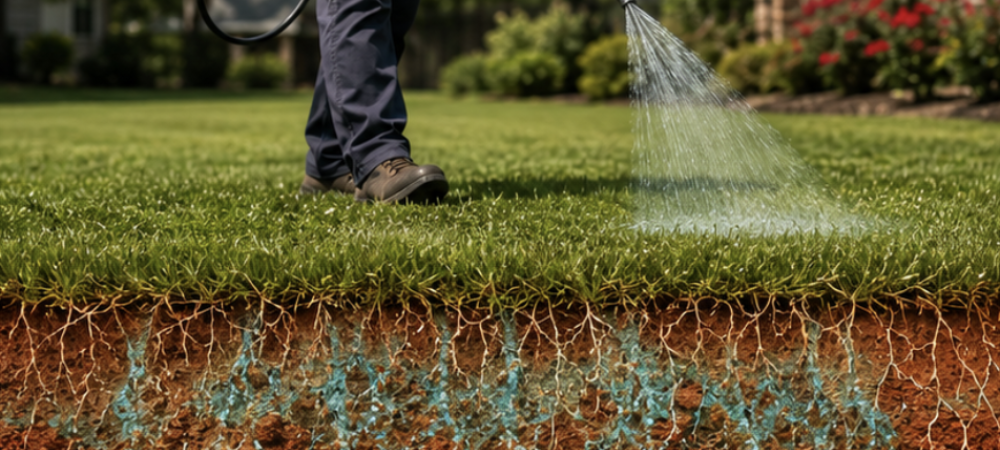
Compacted soil is not always obvious from the surface. Your lawn may still look green in spots, but underneath, tight soil can limit root growth, slow water absorption, and keep fertilizer from reaching the areas where it can actually help. Core aeration creates physical openings in the soil, but liquid aeration works differently by improving soil movement across a wider treated area, including the spaces mechanical tines (the metal spikes or prongs on an aerator) may miss.
Quick Hits
- Red clay compacts at the particle level — liquid aeration uses humic acid chemistry to address this where mechanical equipment cannot.
- The two methods are complementary, not competing — core aeration opens physical channels; liquid aeration improves permeability throughout the soil between those channels.
- Liquid aeration is the right choice when core aeration creates risk — newly sodded lawns, properties with invisible pet fences, or lawns with shallow irrigation heads.
What Makes Red Clay Different
The Piedmont soils across Madison, Monroe, and Covington are dominated by Ultisols — fine-textured red clay that packs tightly under foot traffic and rain. Water pools on the surface because it can't infiltrate. Roots grow horizontally because the deeper soil is too compacted to penetrate. Fertilizer applied at the surface struggles to reach the root zone.
Core aeration physically removes plugs of soil to create open channels — immediately valuable, especially on Bermuda and Zoysia lawns in spring. But tines only treat the 10 to 20 percent of the surface where they actually penetrate, and only to the depth they're set (typically 2 to 3 inches). Compaction in the soil below that depth, and between the holes, goes unaddressed.
How Liquid Aeration Works on Clay
Liquid aeration works chemically, at the particle level. The humic acid in a liquid aeration treatment inserts between individual clay platelets and reduces the electrostatic attraction that holds them packed together, creating pore space throughout the treated area, not just at the tine holes. The humic acid also functions as an organic biostimulant that feeds soil biology and supports root development over time. It reaches the full soil surface, including the majority of the lawn a core aerator never passes over.
When to Use Liquid Aeration Instead of Core
There are situations where liquid aeration is the better choice regardless of compaction level:
- Newly sodded lawns — sod needs time to root before mechanical aeration is safe
- Properties with invisible pet fences or shallow irrigation heads — tines can cut wire and crack heads
- Mid-season treatment — liquid aeration can be applied April through September without the recovery stress of mechanical aeration
According to the University of Georgia Cooperative Extension, aeration timing and method should align with your grass type's active growth cycle.
Not Sure Which Approach Your Lawn Needs?
Alliance TSP, Inc. offers both liquid and core aeration services throughout Georgia. We assess your grass type, soil conditions, and timing to recommend the right approach. Contact us for a professional inspection and to get a free quote.